Showing posts with label Crown Ministries. Show all posts

Wednesday, May 07, 2008

Slightly new focus for our church

Our church, Crossroads Fellowship, sent out an email with a slightly new short term focus which mirrors many of my thoughts and how God is leading me. That is, to help people identify the problems they have with managing their finances and put together a plan to get out of debt and on to a journey of complete financial freedom. Here is what the church sent out today:

If you were unable to worship with us this past Sunday, you can read about our journey with God and how He's leading us in 2008 at www.crossroads.org/pdf/Imagine_Journey_2008.pdf. You can follow along as I walk you through this vision document at www.crossroads.org/audio/Chuck_Imagine_2008.wmv.

If you need help getting out of debt and managing your debt flow our Financial Freedom Ministry provides classes, workshops, resources and budget coaching to help people realize financial freedom. You can discover ways to get out of debt, establish a budget and learn about God's view of money. Take the Crossroads Financial Freedom Personal Assessment at www.crossroads.org/pdf/FF_Personal_Assessment.pdf.

On Saturday, May 17, we are offering a special workshop from 8:30 am - 3:00 pm to help you gain insights that will put you on the path towards financial freedom. Topics include Super Savings, Relating with Money, Dumping Debt and Cash Flow. There will be times when you can meet privately with a budget coach as well as prepare your own action plan for getting out of debt and handling finances God's way. Register online. Cost is $25 per couple and lunch and child care will be provided.

Here are some amazing facts from the charts:
• 70% of Americans live paycheck to paycheck.
• 95% of married couples fight over money and it is the leading cause of divorce.
• Americans spent $1.22 for every $1 they earned in 2007.
• 1 in 6 families may have their homes foreclosed on in 2008.
• 62% of Americans will retire with less than $10,000 income per year.
• Average 28 year old has $66,000 in consumer debt (cars, credit cards and student loans).
• 1 in 7 families is dealing with a debt collector.
• Children today are just as likely to see their parent’s file for bankruptcy as they are for divorce.
• The average household has at LEAST $9,000 in credit card debt.

Monday, March 10, 2008

Sunk Cost Dilemma -- "Live like no one else today..."


"... So you can live like no one else tomorrow." Is a good quote used often by Dave Ramsey. I am not sure if he originated it, but I do like it. Dave Ramsey is one of the most vocal anti-debt voices out there in the world. What amazes me is that those who are vocally anti-debt like myself, are often those who were on the brink of serious financial disaster at some point. But some who were there get right back in debt.

My new theory is that there are two reactions to being close to financial ruin, fight back and change your ways completely or do just enough to survive another day. Those who fight back are often the ones who change their lifestyle enough to pull out of debt and if it was a serious amount of debt, they did that long enough that they hate debt if for no other reason but because they had to live a very limited lifestyle while getting out of debt. Every financial adviser has a similar blueprint as to how to get out of debt which goes something like this:
1. Establish a budget that minimizes expenses and maximizes debt payments.
2. Save a $1000 emergency fund so you don't pile emergencies on credit cards.
3. Pay off unsecured debts using either the debt snowball (smallest first then put all that money on the next largest) or by paying off the highest interest rates first.

This simple formula can be seen in the Wall Street Journal, Washington Post, New York Times, USA Today, by Financial Advisers like Fidelity Investments, by Dave Ramsey, and through ministries like Crown Financial Ministries. Whats amazing is the difference of what you do afterwards. Do you pay off secured debts or not?

Secured debts are those which have some backing collateral, like a car or a house. The difference between some of the advice and others is whether they suggest you pay off secured debts to eliminate the risk of debt in your life or not. The aggressive financial adviser wants you to start pouring the money into their service and quickly will point out that you can get a higher rate of return (they may quote anywhere from 8-14%) from mutual funds than your interest rate on your secured debt (4-7%), so its not important to dump the extra money into your secured debt. Others, like Dave Ramsey and Crown would point out that this is known as the sunk cost dilemma.

The sunk cost dilemma is an economic principle that points out that people who have already committed to one path (like paying a car loan, student loan, or mortgage) will choose to stay on that path rather than review if this really makes sense. For example, would you borrow against your house to put the money in the stock market? If so, you are a big risk taker, most would not. Well, this is essentially what you are doing with a mortgage if you are putting money into the stock market instead of paying off your house.

Dave Ramsey and Crown would also point out Proverbs 22:7, "The Borrower is slave to the lender."

The bottom line is, "Live like no one else today." Don't fall prey to the sunk cost dilemma. Pay off the secured debts as well. Then, when you have no debt and can pay yourself a lot more, you will "live like no one else tomorrow."

Sunday, January 13, 2008

The envelope system - Mvelopes.com


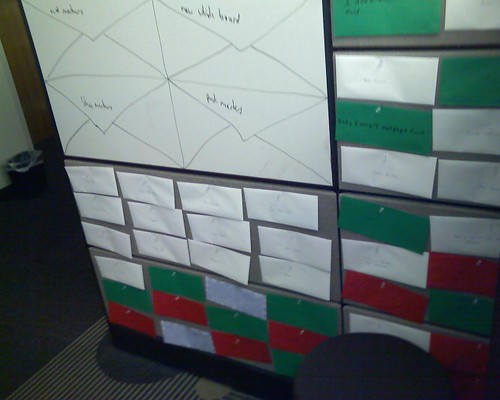
As I was reading through this Sunday's New and Observer, I stumbled upon a reference to Mvelopes in the Wall Street Journal Sunday section by Amy Hoak under an article entitled "Web Sites to Keep You on Budget." Interestingly enough, this is the method Heather and I were featured in the New and Observer for using. Amazingly enough, most of my colleagues and friends had no clue what the envelope system was and I heard more jokes than anything. In fact, my cube walls were covered in envelopes when I returned to work.
Envelopes as cube wallpaper
But, Amy in her article this morning didn't feel the need to expand on what the envelope system was...so I think it must be fairly cut and dry. She said, "[Mvelopes.com] is based on the envelope method of budgeting, which allocated funds by expense category."

Heather and I use Mvelopes and really enjoy it. We found it off of the Crown Ministries website. I think they have a one month trial, but its quite amazing. Even if, like Heather and I, you use a Credit Card for most of your purchases (hopefully with cash back or rewards)...you can easily allocate those expenses to the individual envelopes. I highly recommend checking it out.

Monday, May 07, 2007

Saving, Budgeting, and Marriage...

Heather and I were interviewed by Sue Stock from the N&O, our local newspaper here in Raleigh NC, about how we manage money as a fairly young married couple. The article is here at the N&O including a picture of us with our daughter Anna under More Photos on the right. The experience was great, Sue was nice as well as the photographer, Chris Seward, who spent 45 minutes at our house ot get some various photos of us.

Most of the interview we talked about our system of budgeting, called the envelope system. We didn't develop this system but were taught it by people related to the Crown Financial Ministries organization. Our church, Crossroads Fellowship, teaches part of the Crown curriculum as well as information from other popular financial freedom ministries and personalities like Dave Ramsey. As part of enforcing our envelope system, which I will describe in more detail in a second, we use Crown's Money Matters software which they now call Money Map software. They also have an online budgeting software package called Mvelopes which also budgets with an envelope system.

The first key concept in our system comes down to the order in which you handle your money. When we first receive money, Heather divides it into the envelopes immediately. First, we give back to God a portion of the income He has blessed us with in our tithes. Next, we save a portion of our income in a variety of ways, general savings, emergency savings, college savings, college investments, new car savings, general investments, and other such categories. This keeps savings as a priority in our lives and moves the money away from where we are likely to spend it on a whim. Next, the money gets allocated to the various other account "envelopes" we have. This includes things like our utility bills which can be static or dynamic as well as our grocery and gasoline envelopes which we can use throughout the month. There are other envelopes that gather money to be spent later in the year, like travel envelopes, gift envelopes, or our personal envelopes which Heather and I can use personally at our own discretion.

When the month is over, some envelopes may still have a balance and others may not. Things like our grocery and electric bill envelope both often may have balances. However, whereas the grocery bill envelope probably doesn't need a month to month balance carryover, the electric bill does so that there is more money available in a hot summer. The leftover money in the grocery bill may be carried over to spend on a fancy meal the next month or be pushed into general savings for usage elsewhere as needed.

Overall, this system has worked nicely for us. But, a budget system alone doesn't help people stay on budget. It also requires discipline which is the personal struggle for me. Heather is very disciplined but I am not. So, one of the useful tricks which is available with the envelope system is to not make it virtual in the areas where you are having problems staying on budget. For example, if you cannot stay on track with eating out because it just goes on your credit card, we would suggest you move to cash in an envelope to pay for all of your eating out. Its easy to tell if you have enough money when you just have cash in an envelope.

Thats all for now...I may write some more later...